Here's what most analysts miss about hybrid drones in emergency response: the aircraft isn't the story. The mission profile is.
By the time Curtis Foster, incident commander, called for aerial support on that late-summer afternoon, the fire had already consumed homes and was pushing toward a second ridge. The team didn't need a drone. They needed persistent eyes at altitude, a thermal sensor that could stay over the work long enough to matter, and a communication relay that wouldn't drop when the repeaters on the hillside burned.
That's a different requirement, and it changes everything about the airframe you choose.
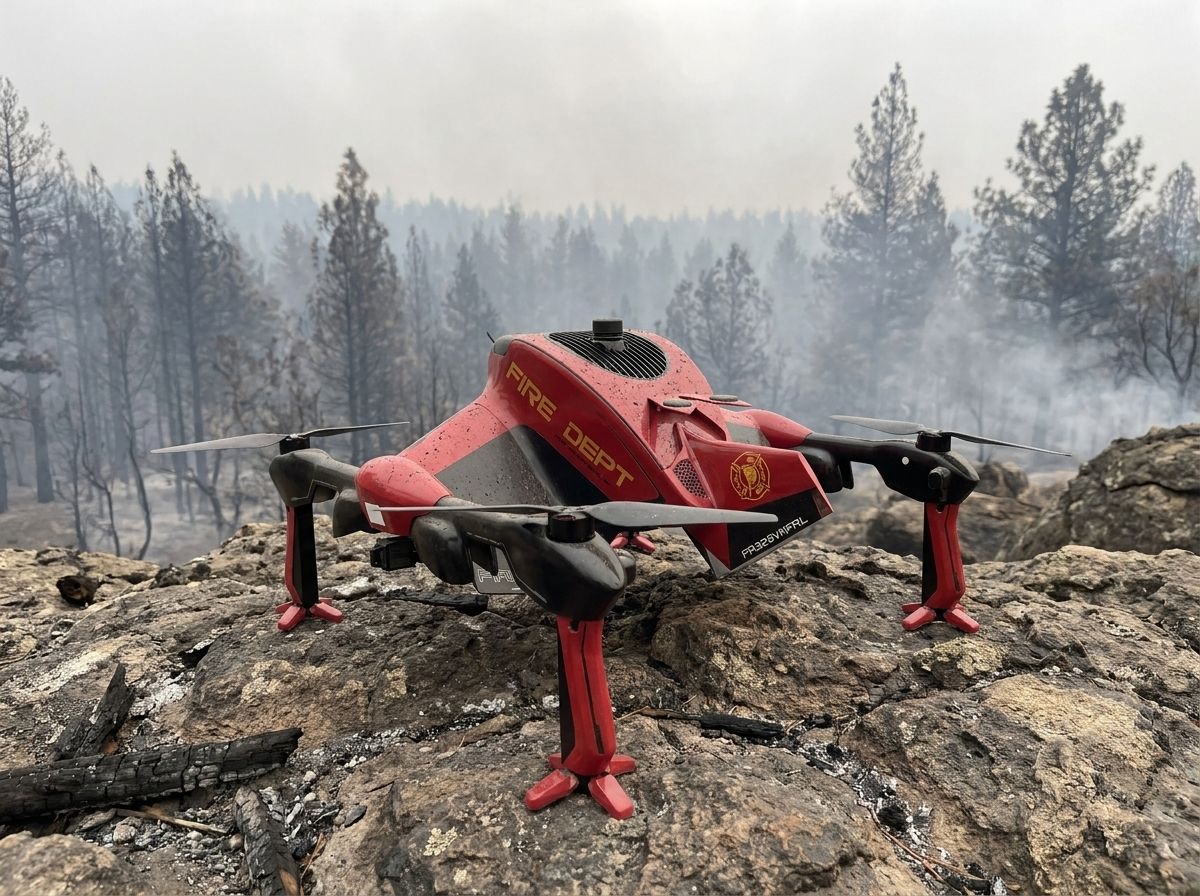
Understanding the operational advantages of hybrid drones
Hybrid drones combine the vertical lift of a multirotor with the endurance profile of a fixed-wing platform. That pairing lets them hold station over a tight urban block or range across a fire perimeter without the kind of battery-swap logistics that pull a crew off their primary task.
For first responders, the operational gap this closes is specific.
- Extended flight time: A hybrid powertrain stretches mission time well past what a battery-only platform can sustain. Compare the DJI Matrice 350 RTK at up to 55 minutes of flight time against a hybrid system running a multi-hour sortie without returning to the staging area. In a wildfire that has been burning for 11 hours with shifting wind, that delta isn't incremental. It's the difference between continuous situational awareness and gaps.
- Enhanced payload capacity: The Matrice 350 carries up to 2.7 kg of payload. Longer-endurance platforms like the AeroVironment JUMP 20 push 30 lb across a 13-plus-hour window. Heavier payloads mean real sensor packages, not stripped-down optics. Thermal imagers, communication relay hardware, drop kits for medical supplies. That's what changes operator outcomes.
- Increased versatility: Search and rescue, perimeter mapping, damage assessment, communication bridging. A single airframe that can handle all of these across a multi-day incident is a force multiplier in the literal sense. You stop managing a drone program and start managing a persistent aerial capability.
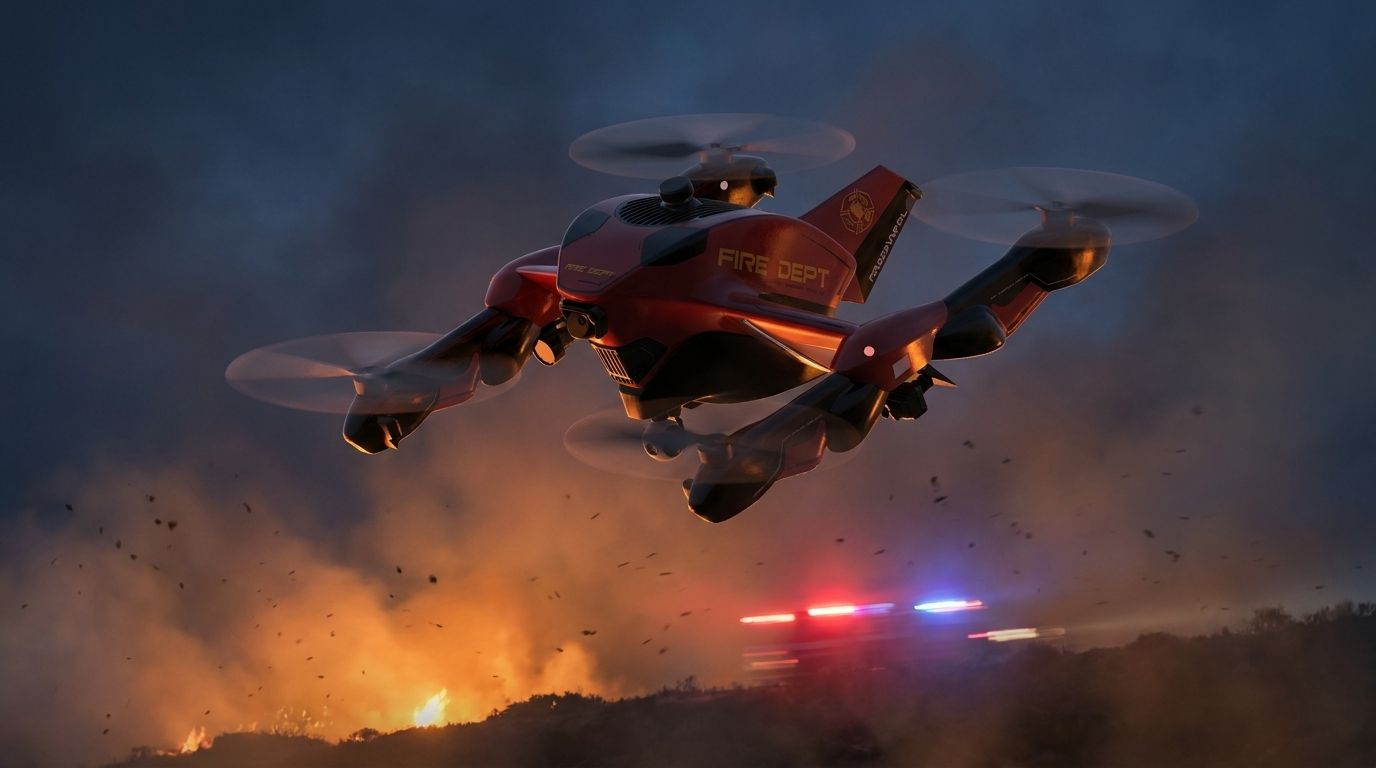
As Curtis monitored the live feed from the Fire-Flight model, the thermal layer was already marking hotspots the ground crew couldn't see from the staging area. Not because the fire was hidden, but because the vantage point changed what was visible.
Real-world application: A case study
In August 2023, a wildfire pushed out of the hills and into the urban fringe of a major city. Curtis and his team were among the first responders on scene. The hybrid drone didn't replace their judgment; it extended their reach.
The aerial survey identified civilian escape corridors that ground teams hadn't mapped yet. Then the drone found something the ground teams couldn't have: a small group of hikers, cut off by a finger of fire, showing up clearly on thermal. Curtis directed rescue teams directly to their position. The extraction was fast, and it worked.
Here's the part most people miss. That rescue didn't happen because the drone was flying. It happened because the drone was still flying, late in the incident, with enough payload margin left to run a thermal sensor at the resolution you actually need to distinguish a person from a heat-soaked boulder.
Three things the drone's sustained presence made possible across the full incident:
- Data collection during crisis: Aerial footage and thermal logs from the full incident window gave post-incident analysts something they almost never have: a continuous record. That kind of documentation reshapes resource planning for the next event.
- Communication enhancement: The drone ran as a relay node between ground teams and the command center when terrestrial comms degraded. In a fire environment, that's not an edge case. It's the expected failure mode. (If you've operated in a canyon with active fire, you already know how fast the radio picture falls apart.)
- Public safety coordination: Real-time positional data fed directly into the public-facing evacuation communications Curtis's team was pushing through local channels. Accurate, current information, not a guess from an hour ago.
The emotional impact of hybrid drones
This part gets underreported.
First responders make better decisions when they have a clear picture. Not just tactically, but psychologically. Curtis's team knew what was behind the next ridge before they committed. That's not a morale story. That's a cognitive load story. Uncertainty is expensive in high-stakes environments, and aerial persistence reduces it.
Three things that shifted for the team:
- Morale and confidence: Knowing the aerial layer was active and stable changed how the crew operated. Less reactive, more deliberate. That's a direct performance input.
- Community trust: The public watched first responders deploy sophisticated aerial assets in real time. Evacuation compliance was higher. Panic was lower. The causal chain there is short and direct.
- Personal anchors: Curtis still talks about the hikers. The drone didn't rescue them. His team did. But the drone is why his team knew where to go.
Practical takeaways for integrating hybrid drones into emergency response
So the deeper lesson is that the airframe decision is downstream of the mission architecture. You don't start with a drone spec. You start with the operational requirement and work backward.
For agencies working through that process, four things Curtis's experience surfaces:
- Invest in training: Drone operations training is table stakes. What actually matters is training on data interpretation under time pressure. How does a thermal overlay change a tactical call? Who on the team has authority to act on what the sensor shows? That's the workflow question, and most procurement processes never ask it.
- Develop a comprehensive strategy: Identify the specific incident types where persistent aerial coverage changes outcomes. Map those to the airframe's actual capability envelope. Don't architect a sensor fit around best-case empty endurance numbers. Plan for the 11th hour of a complex incident, because that's when the capability gap shows up.
- Foster collaboration: Multi-agency incidents are the norm, not the exception. Shared data standards, coordinated airspace deconfliction, unified command integration. Hybrid drone programs that operate as siloed assets are leaving most of their value on the table.
- Engage with the community: Drone operations in residential airspace generate questions. Answer them before the incident, not after. Agencies that brief their communities on aerial capabilities before a major event have a much easier time maintaining public cooperation when it counts.
FAQ
Why are hybrid drones more effective than traditional drones in emergency response?
The core answer is time-on-station. A battery-only platform like the Matrice 350 RTK gives you up to 55 minutes before you're managing a swap cycle. Hybrid systems extend that window significantly, and they do it while carrying the sensor payloads that actually matter for complex incidents.
How do hybrid drones improve communication during emergencies?
They can operate as airborne relay nodes, bridging ground teams to command infrastructure when terrestrial comms fail. In fire and disaster environments, terrain and atmospheric interference degrade radio links constantly. An aerial relay that stays up for hours is a genuine force multiplier for command coordination.
What training is necessary for first responders using hybrid drones?
Beyond basic airframe operation, the priority is data integration training. How do you read a thermal feed under time pressure? How does aerial positional data feed into incident command decisions in real time? Those are the skills that determine whether the drone changes outcomes or just generates footage.
How can agencies build trust with the community regarding drone use?
Proactive transparency. Explain the operational role before an incident. Show what the sensor sees and what it doesn't. Address privacy concerns directly and specifically. Agencies that treat community engagement as a pre-incident operational requirement, not a PR afterthought, build durable trust.
What I'm telling you is that Curtis's team didn't win that day because they had a sophisticated piece of equipment. They won because the equipment stayed over the work long enough for the work to get done.
The airframe is the platform. Persistence is the mission.