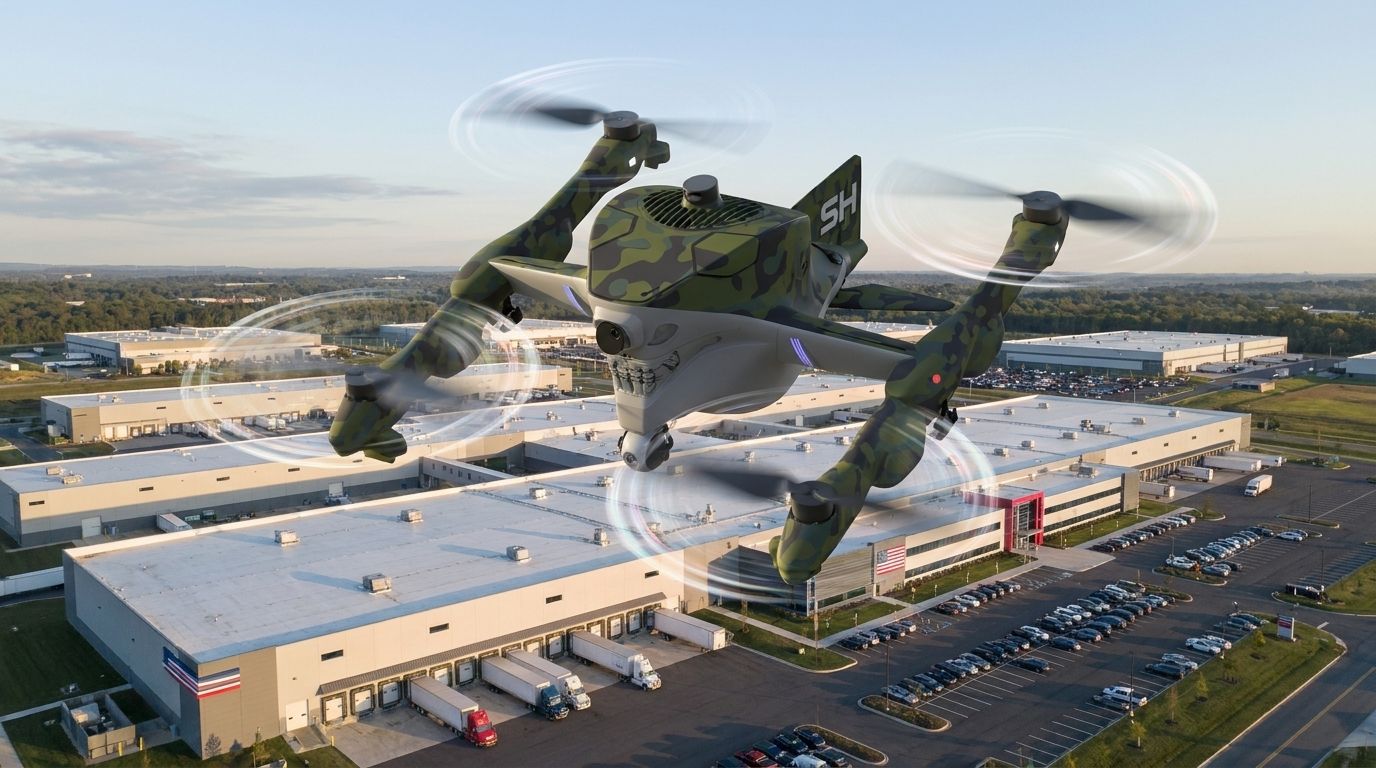
At 02:10 near Fort Moore, Georgia, a small unmanned aircraft returns from a night route with a damaged landing leg and a battery fault. The factory that built it is 700 miles away. The mission does not care. Domestic drone sustainment is credible only when the aircraft can be inspected, repaired, documented, and returned to a controlled flight line without an opaque supply chain.
That is the thesis: an American drone manufacturing audit is incomplete if it stops at the factory door. A serious review must trace the aircraft through maintenance records, carbon-composite repair, propulsion support, software custody, replacement-part provenance, and Section 889 supply chain controls. The factory proves where an aircraft was made. Sustainment proves whether the industrial base can keep it useful.
Start with the mission profile, not the parts catalog
Here's what most procurement teams miss about domestic manufacturing: it doesn't mean domestic assembly. An aircraft can be bolted together in the United States while its repair logic, flight-control software, replacement electronics, or critical tooling sits entirely outside the buyer's practical control.
The deeper audit begins with the Mission Profile. Write down what the aircraft must do after the first hard landing, not just what it must do when new. A fire crew operating near Redding, California may need an aircraft to return after a hot, dusty sortie with ash contamination around its cooling paths. A coastal inspection team near Corpus Christi may face salt exposure, repeated launches, and a payload swap before the next tide window. A government unit at Fort Moore may need a damaged airframe evaluated within the same duty cycle rather than shipped to an unknown subcontractor.
For each mission, document the sustainment consequence:
- What parts are expected to wear, crack, foul, or drift out of tolerance?
- Which repairs can occur at the operating location, and which require controlled shop equipment?
- What inspection method establishes that a carbon-composite structure is safe to return to flight?
- Which records must follow the aircraft from sortie to inspection and back to the flight line?
- What happens when a supplier stops making a board, connector, sensor, or engine component?
This is where U.S. UAV maintenance capability becomes measurable. Do not ask whether a supplier has a maintenance department. Ask what the department can diagnose without forwarding the aircraft into a black box.
A useful audit also separates planned maintenance from recovery maintenance. Planned work fits a calendar. Recovery work begins when the aircraft returns late, damaged, contaminated, or configured differently than expected. The second category is where sustainment architecture earns its keep.
Map the aircraft as a controlled system
A drone is not sustained as a single object. It is sustained as a chain of controlled assemblies, software baselines, tools, records, and people. Your audit should produce a system map that identifies who owns each control point and what evidence exists behind it.
Start with the airframe. For carbon-composite structures, the review should cover laminate records, approved materials, cure data, bond procedures, repair limits, inspection equipment, and technician training. A visual patch is not a structural disposition. The record must show why the repair is acceptable and who made that determination.
Then follow the hybrid powertrain. The inspection should identify control over the engine, generator, fuel system, electrical distribution, batteries, cooling paths, and flight-control interfaces. The question is not whether each component has a supplier. The question is whether the integrated aircraft can be diagnosed when those components interact under load.
A practical system map includes:
- Part numbers, revisions, approved substitutes, and end-of-life notices.
- Serial-number control for airframes, engines, generators, batteries, payload interfaces, and flight computers.
- Tool calibration records and the location of controlled maintenance equipment.
- Software version control, release authority, rollback procedures, and configuration records.
- Defined technical data rights and access rules for the organization performing the repair.
The American drone manufacturing audit should test a sample, not admire the map. Select one aircraft serial number and trace it from material receipt through assembly, acceptance testing, field maintenance, and return-to-flight disposition. Then select one repair event and trace every part, tool, technician, inspection, and software state involved.
If the evidence cannot follow the serial number, the sustainment model is theoretical. A polished factory tour cannot repair a missing record.
Treat carbon-composite repair as an industrial capability
Carbon-composite airframes create a familiar trap. Teams often treat composite work as a specialist craft performed by a few experienced technicians. That may work for a small shop. It is not enough for a government sustainment base that must produce repeatable decisions across shifts, locations, and contract boundaries.
Your audit should examine whether the manufacturer has converted composite knowledge into controlled production and maintenance methods. Review the approved repair schemes, material storage controls, environmental limits, cure equipment, non-destructive inspection methods, and disposition authority. The process must account for damage that is not obvious from the surface, including delamination, crushed cores, bond-line defects, and heat exposure.
Consider a storm response near Savannah, Georgia. An aircraft returns after operating through heavy rain and windborne debris. The visible damage is a small impact near a landing load path. The sustainment question is not whether a technician can make the mark disappear. It is whether the organization can determine the damage boundary, select a documented repair, verify the result, and preserve the aircraft's configuration history.
A credible review asks for evidence in these areas:
- Material certificates and shelf-life controls for carbon cloth, resin, adhesive, core, and protective coatings.
- Repair instructions tied to specific airframe zones and load paths.
- Non-destructive inspection procedures with acceptance criteria.
- Environmental controls for bonding, curing, storage, and post-repair inspection.
- Records that identify the technician, inspector, equipment, material batch, and final disposition.
Do not accept the phrase "field repair" as a substitute for a process. Field repair can mean a controlled mobile capability, or it can mean improvisation under pressure. Those are not the same thing.
Sonin Hybrid's relevance to this audit is straightforward. The company's public engineering focus connects carbon-composite airframes with hybrid-powertrain integration. For an acquirer or manufacturing partner, the question is how that design knowledge becomes repeatable maintenance evidence across the aircraft lifecycle.
Audit the Section 889 supply chain as a living network
Here's the part most people miss: Section 889 is treated like a certification document gathered during proposal prep, checked once, and filed. That's too static. The Section 889 supply chain is a living network that changes when a board is redesigned, a distributor changes ownership, a contract manufacturer adds a sub-tier, or a software tool connects to an external service.
Section 889 of the John S. McCain National Defense Authorization Act for Fiscal Year 2019 established restrictions related to covered telecommunications and video surveillance equipment or services. Federal Acquisition Regulation clauses 52.204-24, 52.204-25, and 52.204-26 create representation, prohibition, and reporting mechanisms for covered equipment and services. The practical audit issue is control: can the supplier identify what enters the aircraft, the maintenance environment, and the supporting information system?
A serious review should examine the supply chain at several levels:
- Direct suppliers for flight computers, radios, navigation equipment, cameras, batteries, engines, generators, and ground-control hardware.
- Sub-tier manufacturers and distributors behind those direct suppliers.
- Firmware, cloud services, remote diagnostics, and software update channels.
- Maintenance tools, laptops, network equipment, and removable media used during sustainment.
- Change-notification procedures when a part, vendor, ownership structure, or manufacturing location changes.
Use a risk-based sample. Select critical items from the bill of materials, then request manufacturer identity, country of manufacture, authorized distribution evidence, and applicable compliance representations. Compare those records against purchasing data and the physical labels on received parts.
The mistake the industry keeps making is treating Section 889 as a procurement form rather than a configuration-management problem. A signed representation does not tell you what changed six months later. Your audit needs a process that detects change and forces a technical and legal review before the replacement enters the fleet.
Test software custody and maintenance data rights
Hardware provenance gets attention because it is visible. Software custody is easier to miss and can be more consequential. A maintenance organization cannot sustain an aircraft if it lacks the approved software baseline, diagnostic tools, interface definitions, or authority to restore a known configuration.
Your audit should identify who controls the source repositories, build environment, release process, cryptographic keys, test data, and field-update method. You also need to understand what happens when a software supplier is acquired, a licensing agreement expires, or a vulnerability requires an urgent patch.
At minimum, examine:
- The configuration baseline associated with each aircraft serial number.
- The authority required to approve and release a flight-control or power-management update.
- Offline recovery procedures when network access is unavailable.
- Test evidence linking a software change to bench, hardware-in-the-loop, and flight-test results.
- Technical data rights needed for the prime, depot, contract manufacturer, or government customer to sustain the aircraft.
Picture a maintenance team at a remote government facility in Alaska during a communications outage. A flight-control computer reports an intermittent fault. The aircraft is physically present, but the engineer who understands the diagnostic package is not. If the team cannot access a controlled offline baseline and a documented troubleshooting path, domestic sustainment has stopped, even though the aircraft never crossed a national border.
This is also where acquisition diligence gets precise. Ask whether the target company owns the knowledge required to maintain the aircraft or merely retains a license to use someone else's tools. Those positions may look identical in a pitch deck. They carry very different continuity risks.
And yes, the spreadsheet will still say "software version." That label is not a sustainment plan.
Measure the maintenance system with failure-based tests
A paper audit can confirm that procedures exist. A failure-based audit shows whether people can use them under pressure. Build a small set of controlled exercises around realistic maintenance events, then observe the time, evidence, decisions, and handoffs.
Do not frame the test as a staged performance. Use representative records and parts. The purpose is to expose dependency on one engineer, one supplier, one software account, or one undocumented habit.
A useful exercise set might include:
- A suspected composite delamination after a hard landing.
- An intermittent generator or power-distribution fault during a scheduled inspection.
- A payload interface change followed by a requirement to restore the prior configuration.
- A supplier notification that a critical electronic component is obsolete.
- A Section 889 review triggered by a new sub-tier manufacturer.
For each exercise, measure the maintenance system rather than the technician alone. Record how long it takes to identify the correct procedure, locate the required tool, verify the part, complete the inspection, update the configuration record, and obtain release authority.
At Naval Air Station Patuxent River, Maryland, an engineering team might have deep test resources nearby (and the institutional memory to match). A small government unit in Arizona or a disaster-response staging area will not. Your audit should show which capabilities remain at the operating location and which depend on an engineering center.
The result should be a sustainment scorecard with evidence behind every rating. Useful fields include:
- Repair authority by component and damage class.
- Mean time to diagnose by failure category.
- Percentage of critical parts with a controlled substitute or obsolescence plan.
- Percentage of maintenance records tied to aircraft serial numbers.
- Number of single-person dependencies in engineering, software, and quality functions.
Do not reduce the scorecard to a single readiness percentage. That hides the failure mode. A fleet can post a strong average while one missing powertrain specialist creates a severe operational gap.
Turn the audit into an acquisition and partner decision
The audit is valuable when it changes what you buy, build, or require from a partner. A strategic acquirer should distinguish between a company with a strong product and a company with a durable sustainment architecture. A contract-manufacturing partner should show where it can take responsibility without creating another opaque handoff.
Ask the target organization to provide an evidence package organized around the aircraft lifecycle. The package should include the configuration baseline, supplier map, Section 889 controls, composite repair system, software custody model, maintenance training records, quality procedures, and sample serialized histories.
Then make the evidence operational. Tie contract language to specific controls:
- Require advance notice for critical supplier, manufacturing-location, and ownership changes.
- Define technical data access for authorized maintenance and repair activities.
- Establish record-retention periods that match the expected aircraft lifecycle.
- Require documented controls for software releases, field updates, and recovery baselines.
- Set escalation paths for counterfeit parts, suspect materials, and Section 889 concerns.
For a defense prime or consolidator, the key question is integration risk. Can the target's sustainment records and engineering methods enter a larger quality system without losing speed or ownership? For a manufacturing partner, the question is execution risk. Can it receive controlled technical data, build repeatable composite structures, integrate hybrid powertrain elements, and preserve traceability through rework?
Select one representative aircraft, one composite repair, one powertrain fault, and one critical supplier. Run the evidence chain from receipt to return-to-flight. If the chain breaks, do not conceal the gap with a broader average. Assign an owner, a due date, and a verification method.
The factory is where the aircraft begins. Sustainment is where industrial credibility is tested. The organization that controls the repair decision, the data, and the supply chain controls whether the aircraft remains a mission asset after the first hard day.
FAQ
What is domestic drone sustainment?
Domestic drone sustainment is the U.S.-controlled capability to inspect, repair, modify, document, and return unmanned aircraft to an approved operating configuration. It includes the airframe, propulsion system, software, technical data, tooling, parts, technicians, and supplier controls required across the aircraft lifecycle.
How does Section 889 affect a drone sustainment audit?
Section 889 requires attention to covered telecommunications and video surveillance equipment or services in federal procurement and related representations. An audit should examine direct and sub-tier suppliers, maintenance networks, software services, and change-control procedures rather than relying on a single signed form.
What evidence should an American drone manufacturing audit require?
The evidence should include serialized build records, material and supplier provenance, composite repair procedures, software configuration history, calibrated-tool records, training records, inspection results, and return-to-flight dispositions. The auditor should trace at least one aircraft and one repair event from origin through maintenance.
How can a buyer evaluate U.S. UAV maintenance capability?
Test realistic failures and measure diagnosis time, tool access, technical-data access, part verification, configuration updates, and release authority. A maintenance organization should demonstrate controlled work at the operating location and identify every dependency on a remote engineer, supplier, or software account.
What should a contract-manufacturing partner show to a defense prime?
The partner should show repeatable carbon-composite production, hybrid-powertrain integration controls, configuration management, supplier visibility, Section 889 processes, repair authority, and records that follow serialized aircraft. It should also define where responsibility ends and where the prime or government organization must assume control.