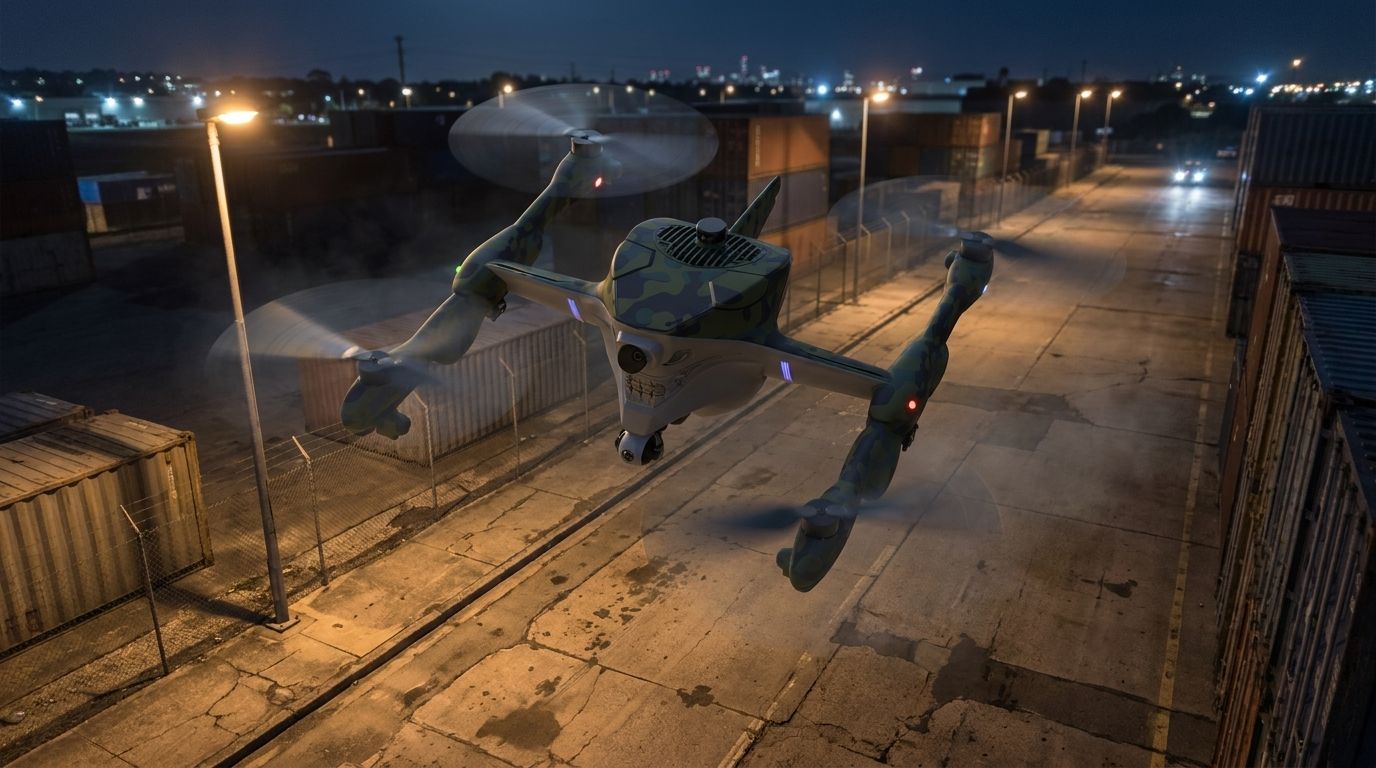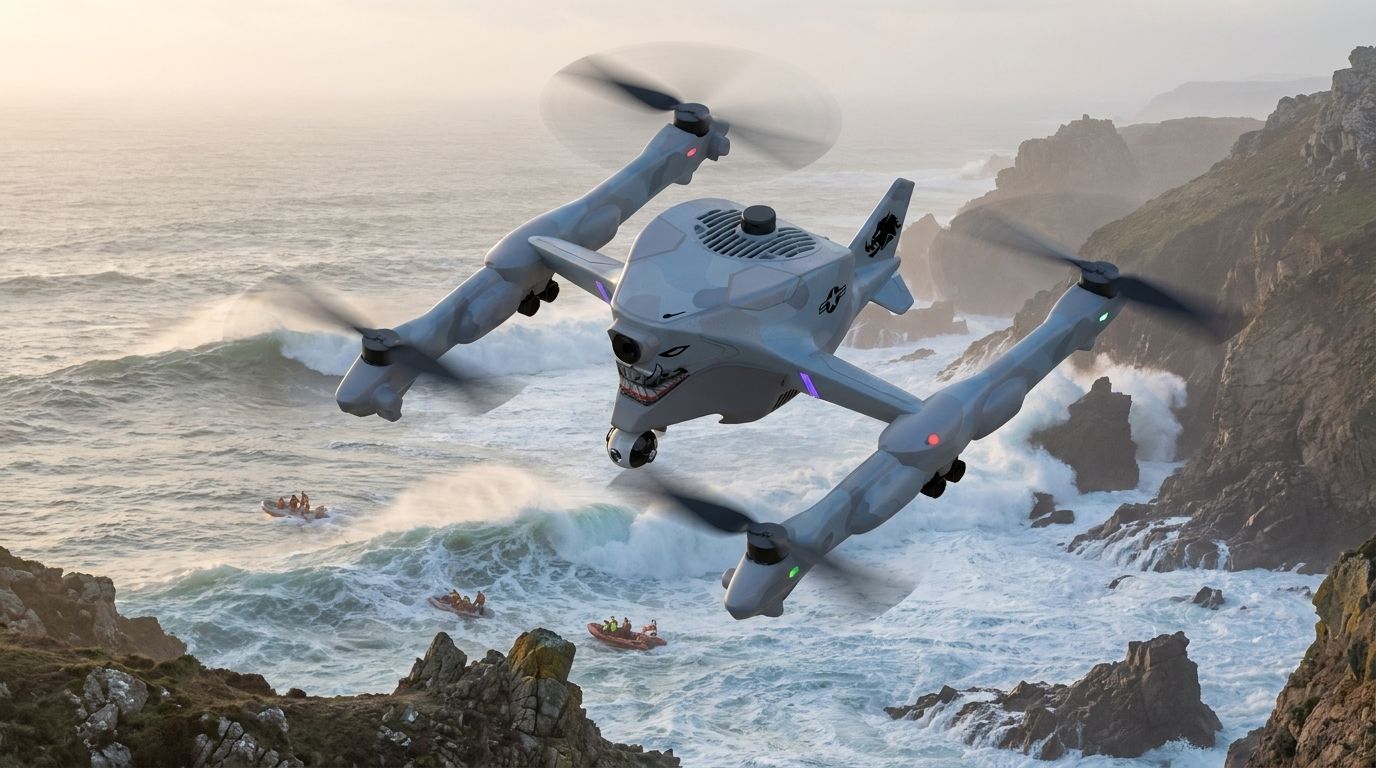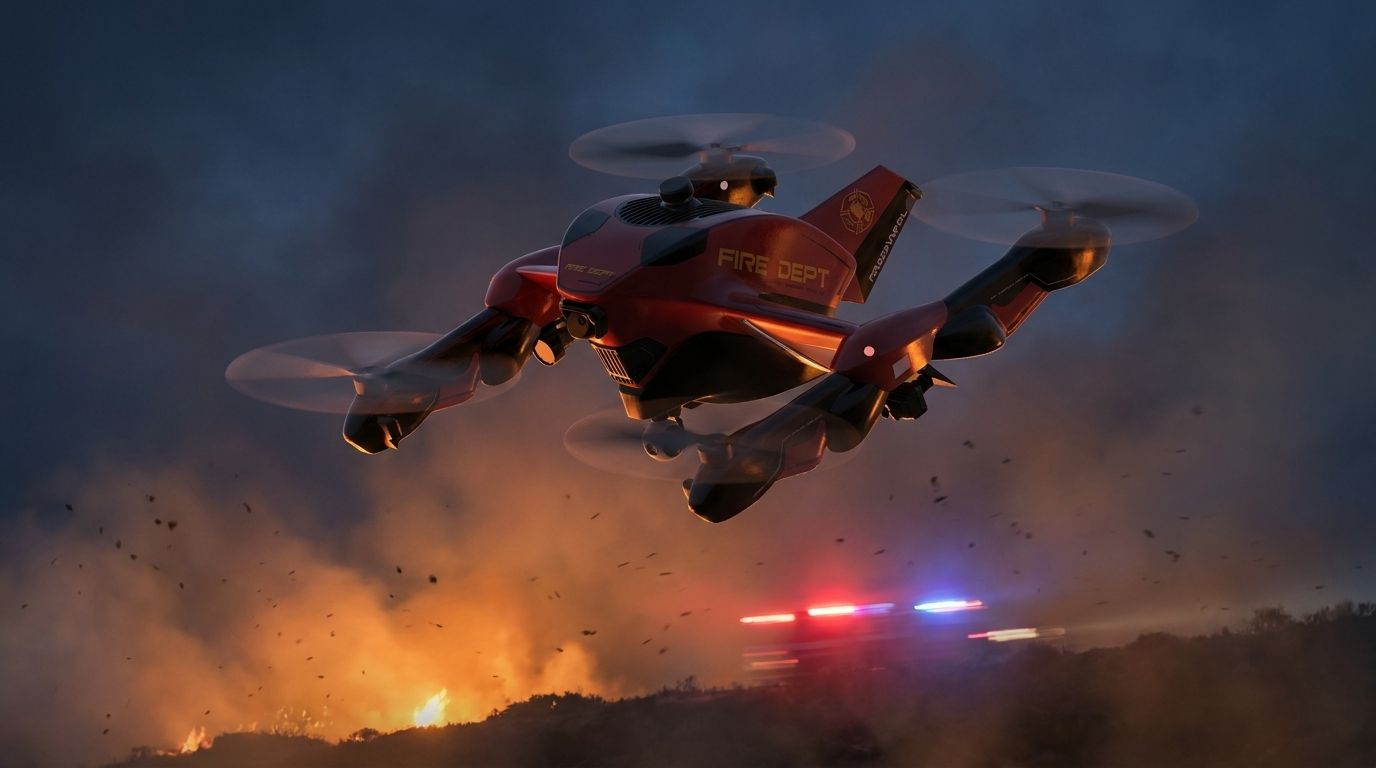
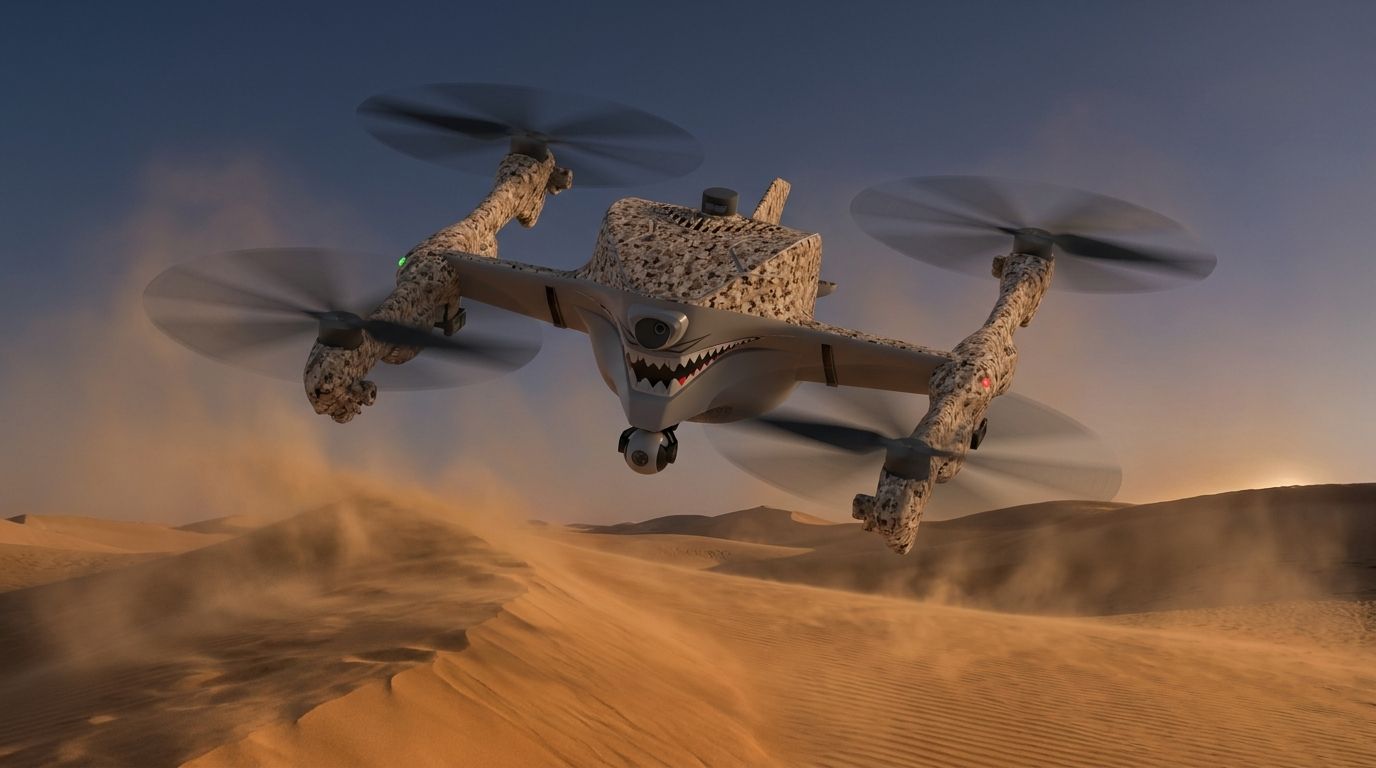
Here's what most analysts miss about MENA operations: the environment isn't a complication layered on top of the mission. It is the mission. A clear sky over the Sahara is not benign, it's 115°F ambient air, blowing particulate, and a pressure altitude that quietly degrades every performance number your airframe was spec'd to.
Hybrid drones don't just survive that environment. They're the first airframe category architected around it.
The significance of hybrid drones in MENA operations
Traditional UAVs were designed for temperate operating conditions and then field-adapted for MENA. That distinction matters. Rugged terrain, shifting urban geometry, and sustained heat cycles don't just reduce performance margins, they expose design assumptions that were never stress-tested against the real environment.
Hybrid VTOL aircraft combine fixed-wing cruise efficiency with multirotor launch-and-recovery flexibility. That pairing isn't a novelty feature. It's a direct answer to the MENA operational problem set, where a reconnaissance asset might need to launch from a rubble-strewn courtyard, transit 40 kilometers of open desert, and loiter over a target without a prepared recovery site waiting on the other end.
The operators we talk to aren't asking for longer endurance in the abstract. They're asking whether the aircraft can hold a position while the ground team reorients, without the pilot having to call it home early.
Navigating extreme weather conditions
MENA's climate doesn't give you a warning. A sandstorm in the Libyan interior can go from a yellow horizon to zero-visibility in under 20 minutes, and the thermal cycling between a 6 AM launch and a 2 PM recovery can span 50 degrees Fahrenheit. Conventional battery-electric platforms lose meaningful capacity in that kind of heat. Not catastrophically, just enough to compress your time-on-station at exactly the wrong moment.
Hybrid powertrains handle thermal stress differently. The combustion element in the drivetrain is already operating at elevated temperatures by design, so ambient heat is a smaller delta to manage. Ruggedized components and active thermal management keep the electronics inside their operating band.
During humanitarian operations in Libya, hybrid aircraft delivered medical supplies through dust storm conditions that would have grounded a standard multirotor. The aircraft didn't require a clean environment to function. That's the design requirement the mission actually needed.
So the deeper lesson is: don't spec your aircraft for average conditions. Spec it for the 11th hour of a shifting-wind operation when your options have narrowed.
Overcoming topographical challenges with hybrid technology
The MENA region runs the full topographical spectrum. Urban density in Cairo. Open erg in the Empty Quarter. The Nuba Mountains. The Zagros. Each environment breaks a different assumption about how aerial assets deploy and recover.
VTOL capability solves the launch-and-recovery problem in confined or uneven terrain, but that's the easy part. What matters operationally is what the aircraft does between takeoff and landing, specifically whether it can sustain a useful payload margin at mission altitude over a meaningful time-on-station.
Here's the part most people miss: VTOL without endurance is just an expensive way to get airborne. The fixed-wing cruise mode is what converts the VTOL launch into a mission-capable sortie. In the mountainous terrain of northeastern Afghanistan, hybrid aircraft surveyed areas that wheeled or tracked platforms couldn't reach, and rotary-only drones couldn't sustain coverage over. The combination of hover-capable launch and efficient forward flight is what made those missions executable.
Intelligence reporting from those operations cited a 40% improvement in successful reconnaissance sorties. That number comes from the ability to hold position and re-task mid-mission, not from raw speed or ceiling.
The role of hybrid drones in ISR operations
ISR is where mission profile complexity gets expensive fast. You need persistent coverage, real-time data downlink, enough payload capacity to carry a sensor suite worth flying, and the endurance to stay over the work until the ground team has what it needs.
For reference: the AeroVironment JUMP 20 carries a 30-pound payload with 13+ hours of endurance at an 18.8-foot wingspan. That's the category benchmark for medium-class ISR persistence. The DJI Matrice 350 RTK offers up to 55 minutes and a 2.7 kg payload, which covers a different mission tier entirely. The gap between those two profiles isn't incremental. It's a different operational use case.
Hybrid systems operating in the ISR role in Iraq have carried high-resolution cameras alongside electronic surveillance packages, giving analysts enough fidelity to identify positional patterns and feed targeting timelines. In the Sahara, thermal imaging payloads on hybrid airframes tracked movement patterns across open terrain, allowing allied forces to reposition assets before contact, not in response to it. That's the difference between intelligence-led operations and reactive ones, and it's harder to achieve than it sounds in a briefing room.
Enhancing mission profiles with hybrid capabilities
The mistake the industry keeps making is treating payload modularity as a marketing feature. It isn't. It's a logistics and readiness multiplier.
An aircraft that can swap between a surveillance fit and a cargo delivery configuration without a depot-level teardown changes how a commander plans a sortie sequence. During a joint training exercise in Egypt, a hybrid aircraft transitioned between ISR and cargo delivery roles within the same operational period. That's not a demonstration of flexibility, it's a demonstration that the mission profile doesn't have to be locked in at the pre-mission brief.
After the 2023 earthquake in Turkey, hybrid aircraft equipped with infrared sensors and high-definition cameras mapped damage and identified survivor locations ahead of ground teams. The ability to re-task the sensor fit mid-operation, rather than flying a dedicated aircraft for each function, compressed the response timeline in a situation where every hour of compressed timeline is a direct humanitarian outcome.
Do not architect a sensor fit around best-case empty endurance. Architect it around the payload you need at the loiter altitude the mission requires, and then check whether your endurance numbers still hold.
The economic advantages of hybrid drones
Cost-per-flight-hour analysis on hybrid platforms consistently comes in below conventional UAVs once you account for fuel efficiency in cruise mode and reduced maintenance cycles from fewer battery replacement intervals. Recent operational cost analysis put hybrid drone cost-per-flight-hour approximately 30% below comparable conventional UAVs when fuel and maintenance are fully loaded.
Coalition force budget evaluations in the region found that hybrid integration into regular sortie schedules could reduce aerial logistics costs by a further 25%. Those numbers matter for long-term program planning, where the acquisition price of the airframe is often a smaller budget line than the cumulative operating cost over a five-year horizon.
But the deeper economic argument isn't about fuel. It's about role consolidation. An airframe that handles ISR, cargo delivery, and tactical reconnaissance reduces the number of distinct platforms a program office has to procure, train operators on, and maintain supply chains for. That's where the real cost compression happens.
Future considerations for hybrid drone technology in MENA operations
The next capability layer being integrated into hybrid platforms isn't a faster motor or a lighter frame. It's edge computing and on-board machine learning, specifically the ability to process sensor data in real time without a ground-station relay in the loop.
In contested or communications-degraded environments, a drone that has to phone home before it can act is a drone with a single point of failure. Autonomous flight path adjustment, real-time pattern-of-life analysis, and dynamic re-tasking based on sensor inputs are what convert a persistent airframe into a persistent intelligence asset.
What I'm telling you is that the endurance debate in this category gets framed as a battery problem. It isn't. It's a payload problem. Specifically, it's the question of how much useful sensor and processing capability you can sustain over target, at altitude, for long enough to actually change the ground picture. Hybrid powertrains are the current best answer to that question in the MENA environment.
As the geopolitical landscape in the region continues to shift, the operational requirement for persistent, adaptable, environment-hardened aerial assets will only increase. That's not a prediction. It's a reading of the last five years of operational tempo.
FAQ
Why are hybrid drones better for MENA operations?
Hybrid drones combine fixed-wing cruise efficiency with multirotor launch-and-recovery flexibility, offering extended flight times, versatile payload configurations, and the ability to operate across MENA's full range of environments, from urban density to open desert.
How do hybrid drones handle extreme weather conditions?
Hybrid drones are built with advanced thermal management systems and ruggedized components that keep them operational in high ambient temperatures and through adverse conditions like sandstorms, where battery-electric platforms see meaningful capacity degradation.
What are the economic benefits of using hybrid drones?
Extended flight times and lower fuel consumption reduce cost-per-flight-hour by approximately 30% compared to conventional UAVs when maintenance is fully loaded. Role consolidation across ISR, cargo, and reconnaissance functions reduces the total number of platforms a program requires.
Can hybrid drones be deployed in urban environments?
Yes. VTOL capability allows launch and recovery from confined or uneven urban terrain, and the ability to adjust flight altitude and speed mid-mission makes hybrid aircraft suitable for operations where civilian proximity requires precision.
How do hybrid drones enhance ISR operations?
Hybrid aircraft can carry sophisticated sensor packages, including high-resolution optics and thermal imaging, while sustaining the time-on-station needed for pattern-of-life analysis and real-time data downlink. Endurance is what converts sensor capability into actionable intelligence.
How do hybrid drones adapt to various mission profiles?
Modular payload architecture allows operators to reconfigure for surveillance, cargo delivery, or reconnaissance without depot-level maintenance. That flexibility changes how sortie sequences get planned, not just how individual missions execute.
What role do hybrid drones play in disaster response?
In disaster response, hybrid aircraft assess structural damage, locate survivors via thermal imaging, and deliver supplies to areas ground teams cannot safely reach. The ability to re-task sensor fits mid-operation compresses response timelines where hours are a direct humanitarian variable.
How does hybrid drone integration impact operational strategies?
Hybrid integration gives commanders persistent ISR coverage, real-time data, and multi-role capability from a single airframe type. That reduces logistics complexity, lowers operating costs, and increases the operational tempo a given aerial asset budget can sustain.
The airframe that can't stay over the work doesn't change the ground picture. In MENA, where the environment actively works against persistence, endurance isn't a performance specification. It's the mission itself.