

The need for persistence in maritime patrol
In the port of Los Angeles, a harbor authority officer squints through binoculars at a drifting fishing vessel, trying to read its intentions from a quarter-mile out. Above him, a hybrid drone holds station - sensors sweeping, recording, waiting. That quiet persistence is exactly what fixed-wing UAVs cannot deliver.
The maritime patrol landscape has changed, but the gaps haven't closed. Fixed-wing drones handle wide-area sweeps efficiently, but they fall apart when an operation demands prolonged, low-speed observation of a single contact. Hybrid multirotor maritime drones fill that void - and for harbor security UAV applications specifically, that distinction is operationally decisive.
The operational cost of limited endurance
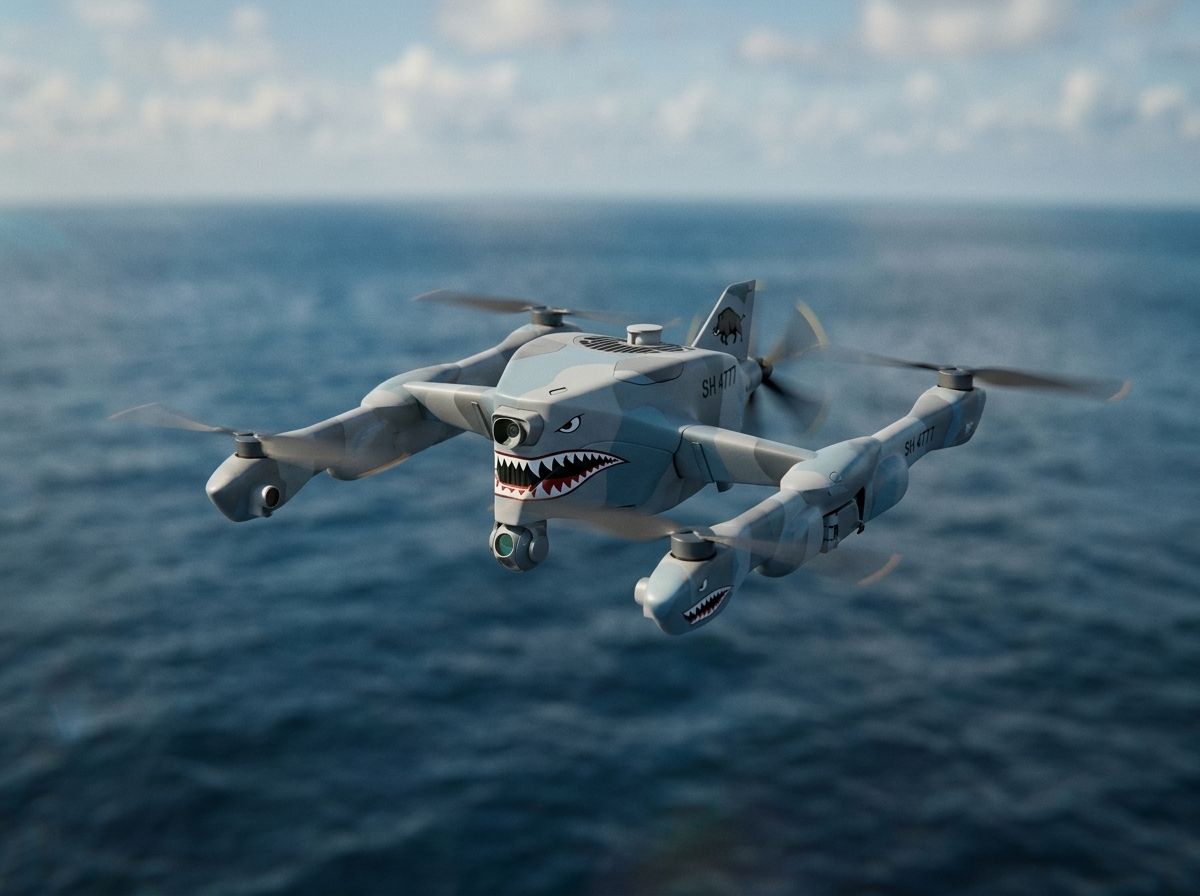
Traditional maritime surveillance leans heavily on fixed-wing UAVs, which cover large areas quickly. The tradeoff: they typically disengage after roughly thirty minutes, leaving harbor authorities and coastal stations without continuous coverage of the vessels or activities that actually matter. A hybrid multirotor like the Recruit Maritime holds position indefinitely - the kind of persistent overwatch that changes how commanders allocate attention.
During 2021 anti-smuggling operations in the Caribbean Sea, authorities struggled to maintain eyes on slow-moving vessels suspected of trafficking. Hybrid maritime drones solved that problem directly, sustaining continuous observation and feeding real-time intelligence to operators who could act on it. The difference wasn't incremental. It was structural.
Advantages of hybrid multirotor technology
Hybrid multirotors combine vertical takeoff and landing with extended endurance - two capabilities that rarely coexist in a single airframe. They transition fluidly between stationary hover, slow-speed tracking, and rapid transit, which means a single asset can shadow a vessel from departure to intercept without handing off coverage.
The Port of Houston put this to practical use in 2020, deploying hybrid drones to monitor vessel movements and flag suspicious activity across Gulf of Mexico approaches. Fixed-wing assets couldn't hold above a specific cargo vessel long enough to be useful. The hybrid drones could - and did. The port reported a 30% increase in effective surveillance time following that integration. That number matters to acquisition decision-makers because it represents capability per flight hour, not just raw endurance.
Real-world applications: maritime security and environmental monitoring
The operational range of hybrid maritime drones extends well beyond security. In 2022, a multi-state coastal operation used hybrid UAVs to monitor algal blooms along the Atlantic seaboard, providing scientists with persistent, high-resolution imagery of affected zones and water-quality data that informed fisheries and tourism policy at the state level.
And then there's the 2023 Super Bowl in Phoenix - not a maritime environment, but a relevant stress test. Hybrid drones provided continuous overwatch of crowd and traffic patterns throughout the event, giving law enforcement a real-time operational picture that static cameras and fixed-wing assets couldn't replicate. Persistent. Flexible. Repositionable on demand.
Case study: the Recruit Maritime drone in action
The Recruit Maritime was purpose-built for the harbor security and port surveillance mission. At the Port of Seattle, during a significant maritime event, it maintained operational altitude over both the water surface and port infrastructure simultaneously - without interfering with vessel traffic or port operations below. Command centers received live video feeds. Tactical decisions followed in real time. That's not a marginal improvement over legacy methods; it's a different operational paradigm.
More consequentially, the Recruit Maritime played a direct role in intercepting a suspected smuggling vessel attempting to bypass port security checkpoints. Its hovering capability allowed it to track the vessel continuously, supplying law enforcement with the positional intelligence that led to apprehension of suspects aboard. The operation demonstrated what persistent aerial coverage actually produces at the tactical edge - evidence, timing, and actionable coordination.
Bridging the gap between land and sea
As maritime operations grow more complex, the technology supporting them has to close the distance between land-based surveillance infrastructure and open-water aerial coverage. Hybrid drones occupy exactly that space. They're well-suited to harbor authorities and coastal stations where close-in monitoring of specific contacts - fishing vessels, cargo ships, small fast movers - demands more than a wide-area pass.
California's commercial fishing enforcement offers a concrete example. Since introducing drone surveillance into their strategy, the state has reported measurable increases in compliance among commercial fishing operators. The mechanism is straightforward: persistent presence changes behavior. Operators who know a drone can hold station above them for hours make different decisions than those who know a fixed-wing asset will be gone in thirty minutes.
But the applications run deeper than enforcement. In 2023, the Florida Fish and Wildlife Conservation Commission used hybrid drones to survey manatee habitats across the state's waterway network, collecting water-quality and habitat data that directly shaped conservation decisions. (That kind of dual-use value - security and environmental - is increasingly what allied-government procurement offices want to see from a single platform.)
Future considerations for maritime patrol operations
The technology maturation curve here is steep. Hybrid multirotor platforms are moving from specialized deployments into standard operational frameworks across search and rescue, environmental monitoring, disaster response, and maritime law enforcement - often within the same agency, sometimes within the same mission.
A 2023 report by the International Maritime Organization flagged advanced technologies as a growing priority in maritime safety doctrine, noting that agencies integrating hybrid drone solutions are positioned for stronger operational readiness. That's not a distant forecast. The agencies standing up hybrid drone programs now are building the institutional knowledge - sensor integration, crew training, command-and-control protocols - that their counterparts will scramble to replicate in three years.
Conclusion: embracing the hybrid solution
Maritime patrol is a complex, contested operational environment, and harbor authorities face demands that conventional UAV architectures weren't designed to meet. Hybrid multirotors address those demands directly: persistence over specific contacts, vertical flexibility, sensor versatility, and the ability to hold station while fixed-wing assets are already on their way home.
For strategic acquirers and integration partners evaluating this space, the Recruit Maritime represents a mature, field-tested expression of hybrid multirotor capability - one with documented operational outcomes across security, environmental, and public-safety missions. The platforms that will define maritime patrol doctrine for the next decade are being evaluated now. Hybrid is not a category to watch. It's a capability to field.
FAQ
What are hybrid multirotor maritime drones?
Hybrid multirotor maritime drones combine the vertical takeoff and landing capabilities of traditional rotary drones with the endurance and efficiency of fixed-wing aircraft. This design allows them to hover for extended periods, making them ideal for close-in maritime surveillance.
How do hybrid drones improve harbor security?
Hybrid drones enhance harbor security by providing persistent, real-time monitoring of vessels and activities. Their ability to hover over specific points of interest allows authorities to gather critical intelligence and respond quickly to potential threats.
Can hybrid drones be used for environmental monitoring?
Yes, hybrid drones are increasingly used for environmental monitoring. They can provide high-resolution imagery and data collection in challenging conditions, enabling agencies to assess ecological impacts, such as algal blooms or oil spills, effectively.
What are the operational limitations of fixed-wing maritime UAVs?
Fixed-wing maritime UAVs are limited by their need for significant runway space and their inability to maintain a stationary position. This makes them less suitable for tasks requiring prolonged observation of specific targets compared to hybrid multirotor drones.
How can agencies integrate hybrid drones into their existing operations?
Agencies can integrate hybrid drones by assessing their current operational needs and identifying areas where drone technology can provide enhanced capabilities. Training personnel and implementing protocols for drone deployment are critical steps in successful integration.
Are there specific regulations governing the use of hybrid drones in maritime operations?
Yes, regulatory frameworks vary by country and region. Agencies must comply with local aviation regulations, maritime laws, and data privacy guidelines when deploying hybrid drones for surveillance and monitoring operations.
What types of sensors can hybrid maritime drones carry?
Hybrid maritime drones can be equipped with a variety of sensors, including high-definition cameras, thermal imaging systems, and environmental monitoring equipment. This versatility allows them to adapt to different operational needs, from security to environmental assessments.