

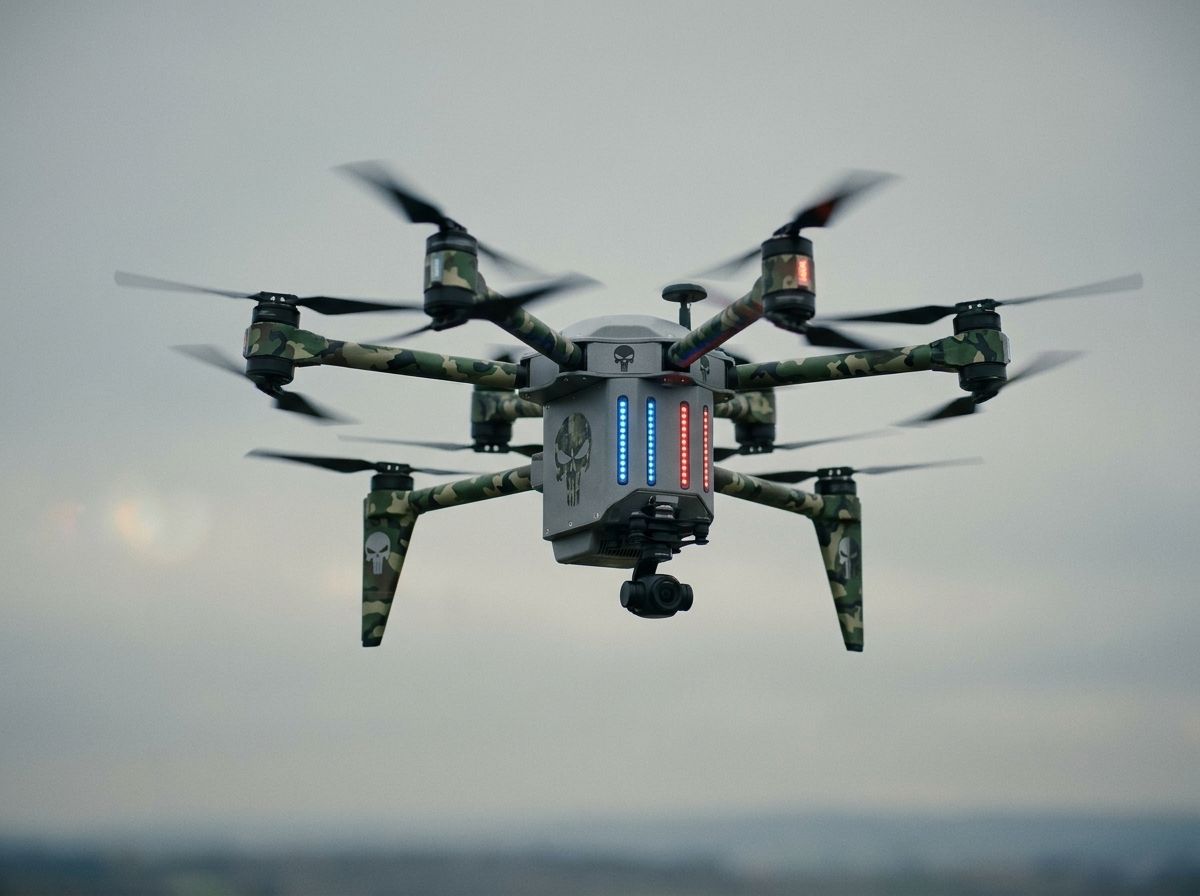
A squad of NATO infantry crouches behind a rocky outcrop somewhere in the eastern Carpathians. Simulated artillery rolls across the ridgeline. One soldier pulls a compact multirotor from a chest-mounted pack - a Euro-One configured Recruit airframe, set up for urban, littoral, and mountainous missions - and puts it in the air. What happens next is not an incremental improvement over legacy systems. It's a different category of capability entirely, and procurement officers who haven't updated their evaluation criteria since the Skydio X10 and DJI Matrice became reference points are already behind.
The evolution of squad-level UAVs in coalition operations
NATO exercises across the last several years have made one operational requirement impossible to ignore: infantry squads need persistent, organic ISR - not borrowed time on a battalion asset, not a 22-minute battery cycle, but real dwell time over a contested objective. Multi-domain operations demand it. The threat environment punishes the absence of it.
Euro-One configured Recruit airframes were developed for exactly that pressure point, where mission outcomes hinge on how fast a squad can acquire, process, and act on ground truth. The broader shift away from large, logistics-heavy UAVs toward man-portable platforms reflects a doctrinal reorientation that's been building since the Nagorno-Karabakh conflict reframed everyone's assumptions about unmanned systems at the tactical edge.
During Saber Strike 2022 in Lithuania, infantry units ran the Euro-One through a multi-national crisis scenario built around urban warfare. Soldiers who'd previously depended on larger systems - systems that required dedicated transport and extended setup - found they could gather actionable intelligence within minutes of contact. That compression of the sensor-to-decision cycle changed how their small-unit leaders planned and reacted, not marginally but fundamentally.
Real-world applications: a closer look at the Euro-One
In a NATO exercise in Romania, soldiers deployed the Euro-One Recruit airframe in a simulated urban combat scenario. The drone pushed live video to ground units, letting them track enemy positions and movements in real time without breaking cover to do it.
The integrated sensor suite - high-resolution EO combined with infrared - proved its value during one particularly sharp moment: a squad identified a prepared ambush site before the engagement window opened, adjusted their approach, and kept the initiative. That's not a training footnote. That's the whole point of organic ISR.
A follow-on joint exercise in Albania's mountainous interior tested the Euro-One's endurance under genuinely demanding terrain conditions. Multi-hour flight times allowed continuous monitoring of troop movements and logistics corridors across ground where a conventional UAV would have required three or four separate sorties - and three or four separate exposure windows - to cover the same picture. The operational flexibility that emerged from those exercises has since worked its way into after-action reports as a capability gap worth closing at scale.
The procurement challenge: bridging the gap
Here's the uncomfortable reality procurement officers are sitting with: the evaluation frameworks most acquisition programs still use were built around a generation of UAVs that the current threat environment has already outpaced.
Systems like the Skydio X10 and DJI Matrice have genuine utility in permissive conditions - nobody serious disputes that. But NATO after-action reports from the last two years consistently flag endurance and autonomous operation in high-threat environments as gaps those platforms can't close. A 2023 report from the NATO Communications and Information Agency made the point explicitly, identifying a procurement framework misalignment between what allied units are asking for in the field and what acquisition pipelines are currently delivering.
Fixing that misalignment requires more than a spec update. Procurement officers need to rebuild their evaluation criteria around endurance, payload flexibility, and deployment speed, then validate those criteria directly against the units doing the missions. The Euro-One's hybrid architecture addresses the endurance problem structurally, enabling flight profiles that battery-electric systems simply can't sustain across terrain types that stress every other variable simultaneously.
Engaging infantry units early in the acquisition cycle isn't a best practice. It's the only way to ensure selected systems reflect operational reality rather than laboratory benchmarks.
Tactical advantages of long-endurance UAVs in coalition settings
A joint exercise along Spain's southern coast illustrated how quickly the Euro-One's multi-environment capability becomes a force multiplier. Ground units and naval elements operated simultaneously, the drone transitioning between urban ISR and maritime surveillance without a platform swap or a logistics pause. During one sequence, the Euro-One identified a potential threat vector against a naval convoy early enough that defensive positioning could be adjusted before the engagement geometry closed.
That kind of cross-domain contribution isn't achievable with single-environment platforms. In coalition settings, where different national units are working from different organic capabilities, the ability to contribute persistent ISR across the full operational picture matters enormously.
The Euro-One's communication architecture compounds this advantage. Real-time data relay to multiple ground control stations and command nodes simultaneously means the intelligence picture doesn't bottleneck at a single echelon. Situational awareness flows laterally across the coalition, which is exactly where interoperability gaps have historically degraded multi-national operations. The tactical advantages here aren't theoretical; they show up in mission completion rates and in the reduction of reactive rather than proactive decision-making at the squad level.
Training and integration: fostering a new operational mindset
Long-endurance multirotors change what infantry units can do, but only if soldiers understand how to use them - not just how to fly them.
A NATO training initiative built around the Euro-One ran workshops where soldiers practiced integrating the system into existing operational frameworks: reading drone feeds, interpreting sensor data under time pressure, and translating that data into immediate tactical decisions. The proficiency gains were measurable, but more importantly, the decision-making confidence gains were visible to unit leaders within a handful of iterations.
During a simulation exercise in Germany, soldiers ran the Euro-One through a mock urban environment, practicing real-time threat response based on live reconnaissance feeds (the scenario design was deliberately ambiguous - multiple possible threat vectors, compressed decision timelines). That kind of training builds the cognitive reflex that makes UAV data useful in contact, rather than just interesting in the debrief.
Training programs need continuous refinement, not annual reviews. Feedback from soldiers running these systems in exercises should feed directly back into protocol updates, because the operational context these platforms are being designed for keeps moving. Standing still on training doctrine while the technology and threat environment evolve is its own form of capability gap.
Future implications for NATO drone procurement
The signal from recent NATO exercises is consistent: traditional UAV platforms are increasingly mismatched to the operational demands allied forces actually face. That's not a fringe assessment - it's showing up in after-action reports, in the 2022 NATO study on advanced UAV integration, and in the conversations procurement officers are having with the units they're supposed to be equipping.
The shift to long-endurance multirotors isn't fundamentally about technology acquisition. It's about rethinking the relationship between infantry units and aerial platforms - what that relationship can accomplish when the platform has genuine endurance, and what it costs when it doesn't.
Multi-domain operations require systems that can move fluidly across land, sea, and air environments without swapping platforms or breaking the ISR chain. Procurement strategies that evaluate UAVs in isolation - against single-environment criteria, without interoperability testing against other NATO assets - will keep producing the same gaps the after-action reports keep documenting. A holistic approach, one that maps the full operational spectrum from squad to command level, is the only framework that produces acquisitions the force can actually use.
The demand signal is clear. The capability exists. The question is whether procurement processes move fast enough to close the gap before the next exercise reveals it again.
FAQ
What are the advantages of using long-endurance multirotors at the squad level?
Long-endurance multirotors deliver persistent ISR support across extended operations - not just a snapshot, but continuous situational awareness throughout a mission. Their compact form factor enables rapid deployment by small units without dedicated support infrastructure. The real-time data they generate compresses the sensor-to-decision cycle in ways that directly affect mission outcomes.
How does the Euro-One compare to traditional UAVs like the Skydio X10 and DJI Matrice?
The Euro-One is configured specifically for squad-level tactical operations across urban, mountainous, and littoral environments - terrain types where conventional battery-electric platforms run out of endurance before the mission runs out of requirements. The hybrid architecture enables flight profiles those systems can't match. The integrated sensor suite, combining high-resolution EO with infrared capability, delivers the data quality that real-time decision-making at the tactical edge actually demands.
What training is necessary for infantry units to effectively utilize multirotors?
Effective integration requires training across three domains: system operation, sensor data interpretation, and tactical application. Soldiers need to practice not just flying the platform but translating its outputs into immediate decisions under operational pressure. Simulated exercises - built around ambiguous threat scenarios with compressed timelines - are the most reliable method for building that proficiency.
How are NATO exercises influencing UAV procurement strategies?
NATO exercises generate after-action data that procurement frameworks can't produce from requirements documents alone. They surface gaps between what acquisition pipelines are delivering and what units need in contact. They also stress-test interoperability assumptions - revealing, often inconveniently, which systems actually communicate across coalition networks and which ones create data silos.
What is the future of UAV technology in coalition operations?
Endurance, cross-domain agility, and real-time data-sharing capacity will define the next generation of operationally relevant UAV platforms. As threat complexity increases and multi-domain operations become the baseline rather than the exception, systems that can sustain persistent ISR across diverse environments - and integrate cleanly with existing NATO assets - will determine which forces maintain the initiative and which ones are always reacting.
How can procurement officers ensure they are selecting the right UAV systems?
Start with the units running the missions, not the spec sheets. After-action reports from NATO exercises provide hard evidence of where current systems fall short. Direct engagement with infantry soldiers and small-unit leaders surfaces requirements that never make it into formal capability documents. That ground-level feedback, combined with rigorous cross-environment performance evaluation, produces procurement decisions the force can actually build doctrine around.
What role do hybrid drones play in modern military operations?
Hybrid platforms like the Euro-One combine vertical takeoff and landing capability with the extended endurance that battery-electric systems can't sustain. That combination is operationally significant: rapid deployment from confined or unprepared positions, followed by multi-hour persistence over the objective. In modern operations that require both agility and dwell time - often simultaneously - hybrid architecture isn't a feature. It's a prerequisite.
The procurement decisions NATO members make in the next acquisition cycle will shape allied force capability for the better part of a decade. The evidence from recent exercises, after-action reports, and operational assessments all point in the same direction. Long-endurance multirotors have moved from emerging capability to operational necessity, and the acquisition frameworks that recognize that shift earliest will be the ones that matter most when it counts.