

Understanding the time-on-station metric
Picture the scene: a remote desert outpost, 114°F on the tarmac, an operator locked onto a live feed from a drone holding position over a checkpoint. Every minute that drone stays aloft is a minute of actionable intelligence. Every minute it doesn't is a gap the enemy owns.
That gap has a name. Time-on-station - the duration a drone can hold a specific position while actively conducting ISR - is the metric that actually determines mission value in desert environments. And it's the one metric procurement doctrine has consistently underweighted.
Heat is the first problem. Battery-only systems routinely absorb a 20% reduction in endurance when ambient temperatures climb into the range that defines desert summer. A platform spec'd at eight hours in a temperate test environment may deliver six - or less - over a Saharan wadi in August. But thermal degradation is only part of the story. Fixed-wing endurance platforms are optimized for area coverage, not position-holding. When the intelligence requirement shifts from "survey the route" to "watch that vehicle," a drone that must keep moving becomes operationally useless, regardless of how many hours it can stay airborne.
The advantages of hybrid power in desert operations
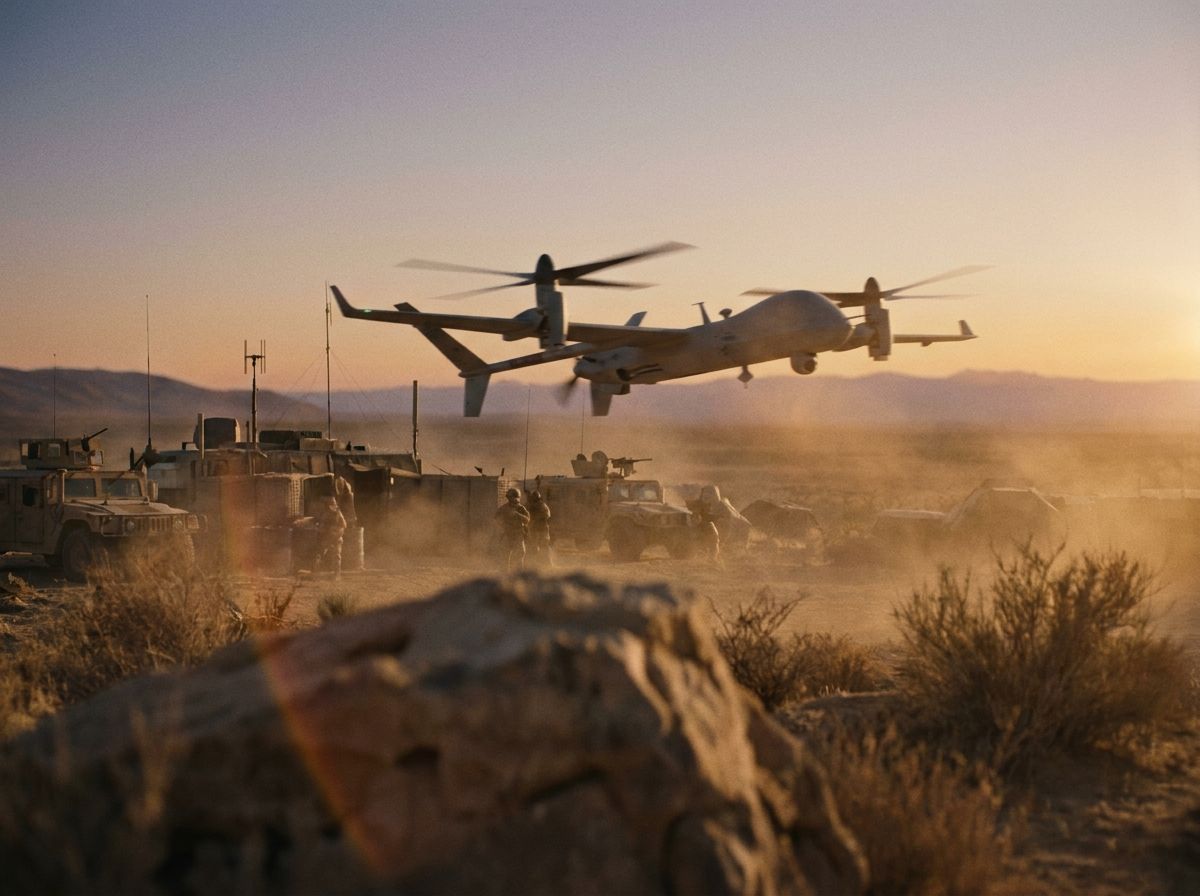
Hybrid power changes that calculus. Sonin Hybrid's Recruit, which combines a battery bus with an onboard fuel-based generator, can sustain a hover for durations that battery-only multirotors cannot approach - and it can do so while powering the kind of sensor packages (EO/IR, SAR, comms relay) that justify the sortie in the first place.
In a UAE field evaluation, the Recruit held a hover for over seven hours while tracking a convoy of military vehicles along a contested desert route. No rotation. No battery swap. No intelligence blackout while the crew relaunched. That matters for more than operational continuity. Every landing is a signature - acoustic, thermal, visual. Every relaunch is a window during which the target moves, the situation evolves, and command is flying blind. Hybrid persistence eliminates those windows.
The system's ability to power sensors and comms simultaneously while hovering is equally significant. Operators can maintain real-time surveillance, push telemetry to a forward command node, and coordinate with ground elements - all without the platform ever touching down.
Real-world scenarios highlighting the importance of hovering capability
The 2021 Northern Africa multinational exercise made the doctrinal gap concrete. A fixed-wing UAV covered the assigned search area efficiently, then struggled to hold position when operators identified a suspected insurgent movement worth watching. Battery constraints forced repositioning cycles. Critical moments passed. The unit absorbed operational setbacks that a hovering-capable platform would have prevented.
The contrast from a comparable Middle East exercise is instructive. A hybrid multirotor held a steady hover over a checkpoint for more than four hours, feeding continuous troop-movement intelligence to command. Decision-makers had what they needed, when they needed it. Operation Inherent Resolve surfaced the same pattern at scale. Traditional fixed-wing ISR assets shaped the operational picture over broad areas but repeatedly failed to deliver the persistent, point-specific observation that engagement decisions require. Hybrid platforms operating in analogous conditions provided commanders a continuous feed of actionable intelligence - the kind that shapes targeting, not just situational awareness.
The doctrinal gap in current procurement strategies
The fixation on endurance-as-range is a legacy of a doctrine built around wide-area surveillance and strike-support for conventional maneuver warfare. It made sense for that problem set. Desert checkpoint operations, convoy monitoring, and persistent site surveillance are a different problem set entirely.
The U.S. Air Force has begun to acknowledge this. Under its Agile Combat Employment initiative, the service is actively evaluating hybrid drone integration for ISR roles in contested environments where traditional fixed-wing platforms create coverage gaps. That institutional signal matters - it suggests the doctrinal update is underway, not theoretical. What hasn't kept pace is the procurement metric itself. Requirements documents still lead with endurance (flight hours, range, transit speed) and treat hovering capability as a secondary specification. Until payload-on-station - the ability to hold a sensor over a target for operationally meaningful durations - becomes a primary acquisition criterion, programs will keep selecting platforms optimized for the wrong variable.
Effective integration of technology and training
Hardware is necessary. It isn't sufficient.
Integrating hybrid multirotors into desert ISR operations demands a parallel investment in how operators think about mission planning. The U.S. Army's experimentation with hybrid systems at Fort Irwin illustrated this clearly: units that approached the Recruit as a "longer-battery quadcopter" underperformed. Units that restructured their observation plans around persistent hover - pre-designating dwell points, building relay schedules, treating the drone's station time as a planning constraint rather than an afterthought - identified enemy positions and delivered actionable intelligence to ground forces at rates that measurably improved mission outcomes.
Scenario-based training in realistic thermal and terrain conditions is the mechanism that closes that gap. Operators who have managed a seven-hour hover through a Mojave afternoon know, in their hands, what the platform can absorb and where its margins live. That knowledge doesn't transfer from a datasheet.
The path forward: prioritizing payload-on-station
Three shifts define the near-term path.
- Rewrite the primary metric. Procurement requirements should lead with payload-on-station duration under operational thermal loads, not maximum endurance under temperate test conditions.
- Standardize the measurement. A common framework for time-on-station testing - agreed across allied acquisition communities - would let programs compare platforms on the variable that actually drives ISR effectiveness in desert theaters.
- Build the industrial base for hybrid integration. Carbon-composite airframe manufacturers and hybrid powertrain integrators need long-term demand signals, not one-off contracts, to develop the production capacity and supply-chain depth that serious procurement requires.
Engagement with allied nations accelerates all three. Joint exercises in desert environments - the kind that generate real operational data rather than controlled test conditions - surface capability gaps faster than any internal review process. And shared data builds the multinational case for procurement alignment that individual programs struggle to achieve alone.
FAQ
What is the time-on-station metric?
Time-on-station measures how long a drone can remain over a specific location while conducting ISR operations. This metric is crucial for effective monitoring and intelligence gathering. In desert conditions, it becomes even more critical as temperatures can significantly impact battery life.
Why is hovering capability important in desert operations?
Hovering capability allows drones to maintain a constant watch over a target area, which is essential for gathering real-time intelligence in environments where conditions can impact battery life. This sustained observation is vital for decision-making and operational success.
How does hybrid power improve desert ISR operations?
Hybrid power systems enable drones to combine battery and fuel power, allowing for longer flight times and sustained hovering capabilities, which are critical in desert ISR missions. This flexibility ensures that drones can effectively monitor areas without the frequent need to recharge.
What are some real-world examples of time-on-station issues?
In various military exercises, fixed-wing drones struggled to maintain position over target areas, leading to missed intelligence opportunities. During Operation Inherent Resolve, traditional drones could not effectively hover over critical locations, while hybrid drones provided continuous intelligence, enhancing mission outcomes.
What should be prioritized in future drone procurement strategies?
Future procurement strategies should prioritize payload-on-station capabilities and hybrid power systems designed for desert environments to ensure effective ISR operations. This includes fostering collaboration between military units and manufacturers to tailor solutions to specific operational needs.
The time-on-station problem won't resolve itself. Procurement doctrine that continues to measure endurance in miles rather than minutes-over-target will keep generating the same operational gaps - documented in after-action reports, absorbed as acceptable loss, and repeated in the next exercise. The metric drives the acquisition, the acquisition drives the capability, and the capability determines what commanders can actually do when a convoy stops at a wadi and no one knows why.
Hybrid persistent hover is the answer to that question. The doctrine just needs to catch up.